

Audio Transcription converts speech and conversations from audio recordings into accurate, readable text. It transforms real-world audio into searchable, organized, and AI-ready data for documentation, analysis, and machine learning applications.
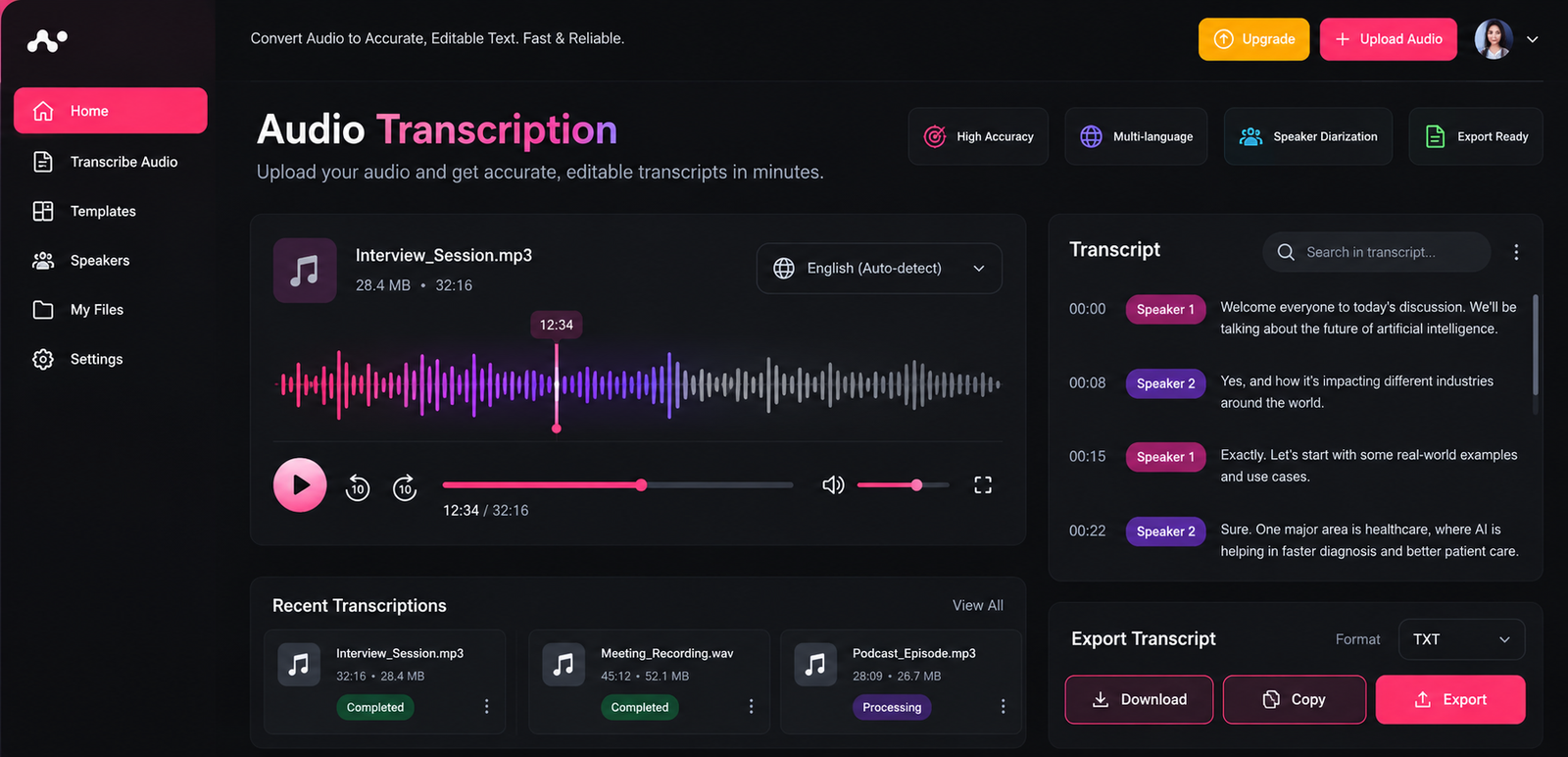
Convert spoken conversations into clear, accurate, and readable text while preserving the original meaning. This makes audio content easier to document, review, and reuse.
Identify and differentiate between multiple speakers in conversations, interviews, meetings, and discussions. This creates organized transcripts that clearly show who said what.
Add precise timestamps to help users quickly locate specific words, conversations, or moments within an audio recording. This makes lengthy recordings faster to navigate and review.
Transcribe speech across different languages, accents, dialects, and speaking styles. This helps create more inclusive datasets and supports global content processing.
Capture industry-specific terminology, phrases, and conversational context instead of relying only on word-for-word conversion. This produces transcripts that better reflect the meaning of the original speech.
Process recordings with varying audio conditions while identifying challenges such as background noise, overlapping speech, or unclear sections. This helps produce cleaner and more usable transcripts from real-world recordings.
Transform spoken information into searchable text that can be indexed, categorized, analyzed, and repurposed. This turns large audio libraries into easily accessible information resources.
Create structured transcripts that can support NLP, speech recognition, conversational AI, and machine learning workflows. High-quality transcription provides AI systems with valuable real-world language data.







Audio Transcription is the process of converting spoken words from audio recordings into accurate, readable text. It helps transform conversations, interviews, meetings, podcasts, and other recordings into searchable and usable content.
Audio transcription can be used for interviews, meetings, calls, podcasts, lectures, voice recordings, and other speech-based content. It can support different languages, accents, speakers, and audio formats depending on project requirements.
Transcribed audio makes spoken information easier to search, review, document, and analyze. It can support content creation, meeting records, customer insights, accessibility, knowledge management, and AI workflows.
Yes, accurate transcripts can be converted into structured datasets for speech recognition, NLP, conversational AI, and machine learning applications. High-quality transcription helps AI systems learn from real-world spoken language more effectively.